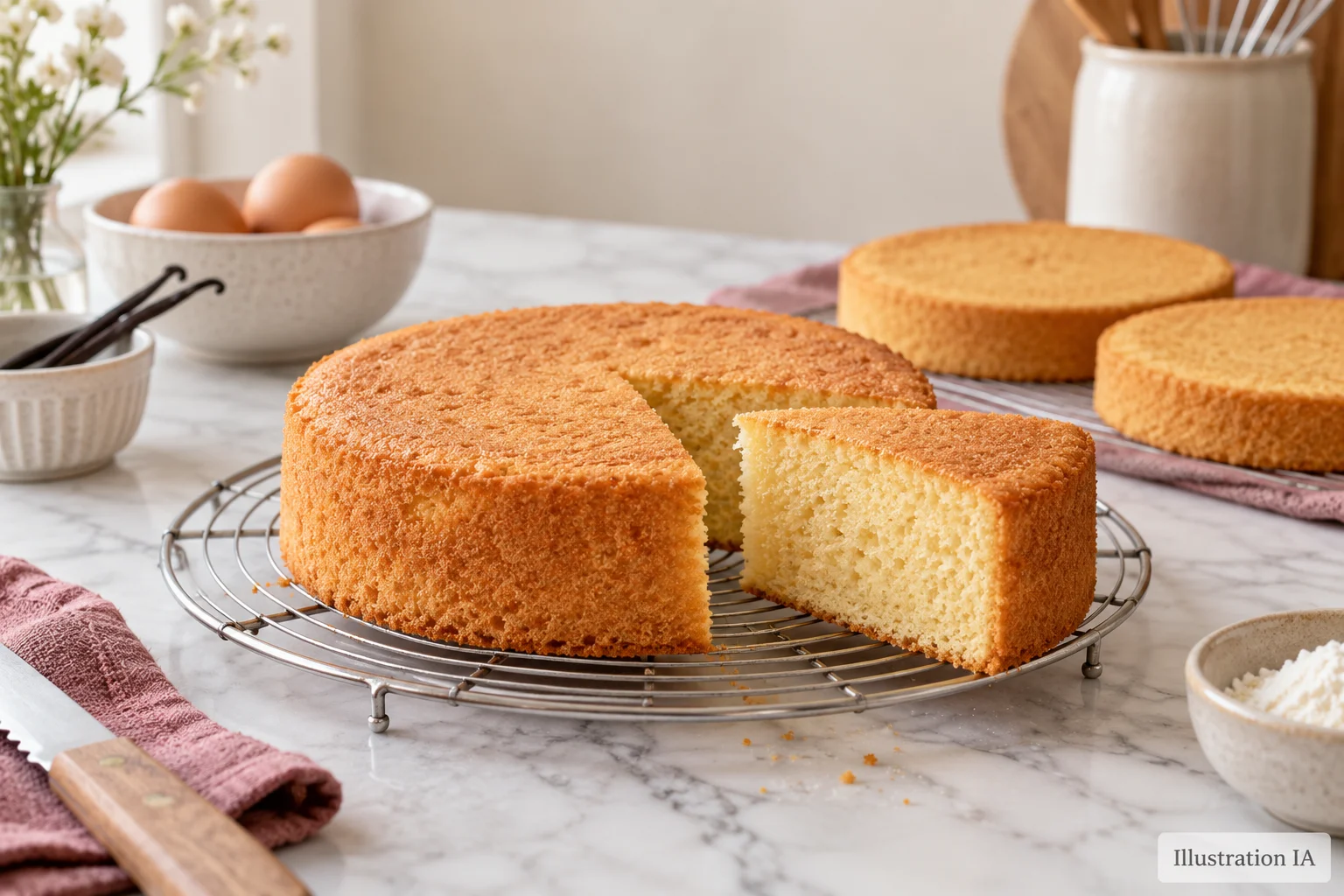
Performance: About 711 g of batter for three 15 cm layers baked separately. Measure their height after your trial bake.
Cooking: 170 °C · Conventional oven (no fan) · 18–25 min. These timings are for three separate tins. For a tall sponge to slice into layers, use one 15 cm × 10 cm tin and line the sides with a collar of baking parchment that extends above the rim. The 1.3 to 1.6 L of batter will already be 7–9 cm deep before baking. Bake at 170 °C for 40 to 55 minutes, then check the centre. Put the batter straight in the oven so the foam does not collapse.
Taste: Mild egg and vanilla notes let the filling stand out.
Held: Holds its shape once soaked and filled. The sponge alone cannot bear the weight of another tier.
Use: Layer cakes with light fillings such as mascarpone cream or whipped ganache, fruit cakes and variations on fraisier.
Three 15 cm cake tins or one deep 15 cm × 10 cm cake tin · Kitchen scales · Hand mixer or stand mixer with whisk attachment · Heatproof bowl and saucepan for a bain-marie · Sieve, flexible spatula, baking parchment and cooling racks · Probe thermometer
Prepare
Preheat the oven and line the bases of the cake tins. Weigh the ingredients. Melt the butter without browning it, then let it cool until lukewarm.
Warm gently and whisk until thick and airy
Set a bowl over a gently simmering bain-marie. Whisk the eggs, sugar and salt until the mixture reaches 40 to 45 °C and the sugar dissolves. Take the bowl off the heat. Whisk on high for 8 to 10 minutes, then on medium for 2 minutes. The mixture should fall from the whisk in a thick ribbon that stays visible for a few seconds.
Fold in the flour
Sift the flour over the egg foam in three batches. Fold from the bottom with a flexible spatula, turning the bowl as you go. Avoid vigorous circular stirring, which would knock the air out.
Add the butter
Stir a generous spoonful of batter into the lukewarm butter and vanilla, then pour it back over the batter and fold gently. Scrape the bottom of the bowl where the butter tends to settle.
Divide the batter and bake
Divide into three equal portions of about 237 g each. Bake immediately and start checking after 18 minutes.
Check for doneness and cool
The centre should spring back when touched, and the edges should just start to pull away. After 5 minutes turn the cakes out onto a rack, then turn them top-side down onto baking parchment to keep the tops flat. Cool completely before adding syrup or filling.
Tough points
- Get a stable ribbon.
- Stir in flour and butter without dropping the foam.
If you miss the result
The eggs were not whipped enough, or the foam collapsed while folding. — Warm the eggs, whisk to the ribbon stage, then fold from the bottom up.
Unmixed butter sank to the bottom. — Stir a little batter into the butter before folding it into the rest. Scrape the bottom of the bowl.
The sponge was underbaked, or the oven door was opened too soon. — Keep the oven door closed for the first 15 minutes. Check that the centre is baked before removing the sponge.
- Génoise chocolat : see the dedicated recipe.
- Replace 30 g of flour with 30 g of almond powder for a softer genoise. Revise the allergen declaration for the nut actually used.
Conservation & organization
Cool completely, wrap cleanly and use storage conditions validated for the recipe. No shelf life has been established for this sponge. Once filled, follow the requirements of the most perishable component.
Freezing: To test freezing quality, cool the unfilled sponge, wrap it well, label it with the date and thaw it in its wrapping in the refrigerator. No frozen shelf life or thawed quality has been established for this sponge.
Sources consulted: kingarthurbaking.com
Adapt to another mould