Arrange your work over three days
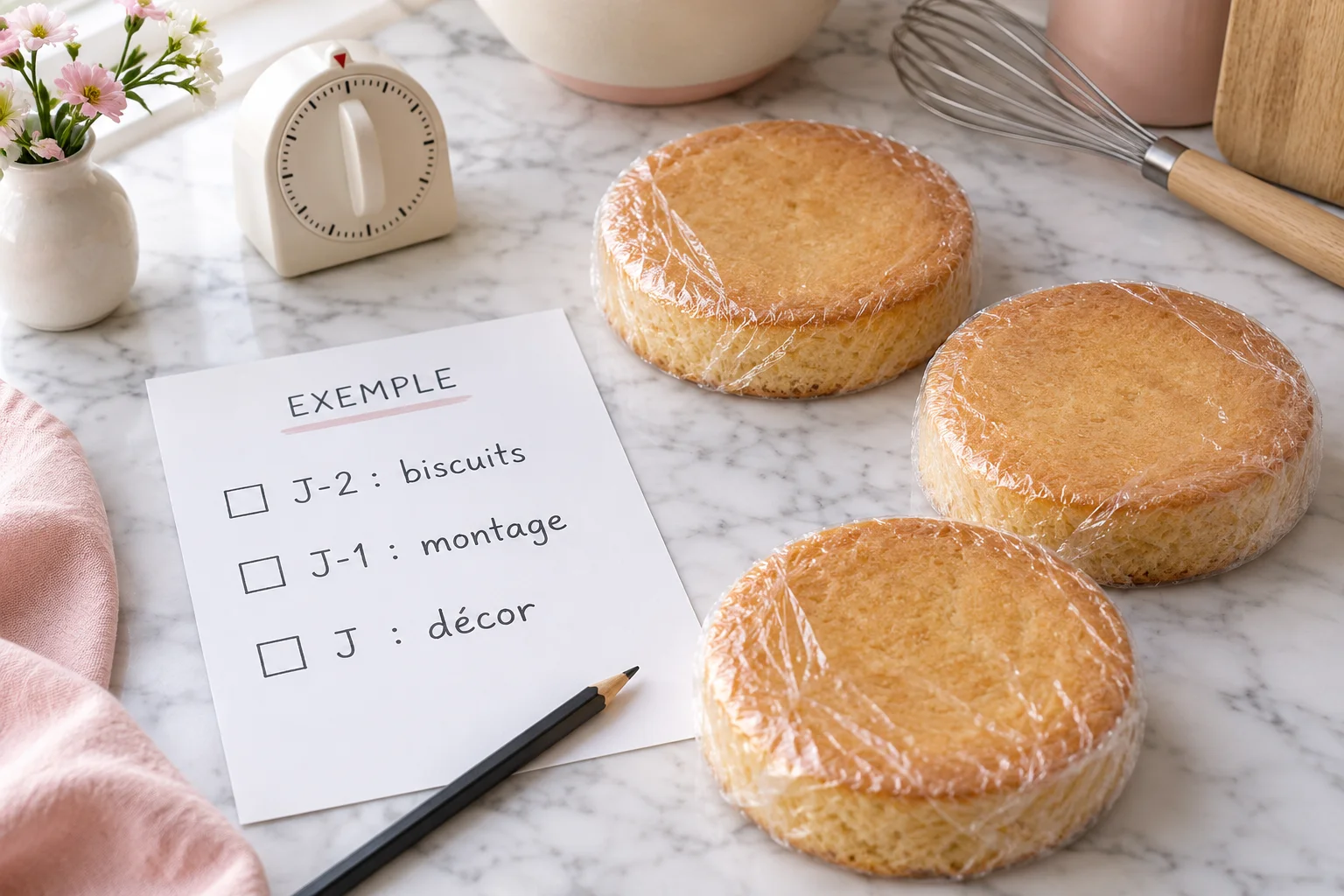
Build a realistic schedule reserving cooling, catch and cold, from J-2 to tasting day.
At the end of this lesson
- Distinguish active work and waiting time.
- Divide the steps over three days depending on what can be anticipated.
- Keep a reproducible production sheet and test sheet.
The model in three days
For delivery on Saturdays, the preparations are distributed in this way. The principle: everything that is preserved is done early, everything that is fragile is late.
| Day | Tasks | Condition |
|---|---|---|
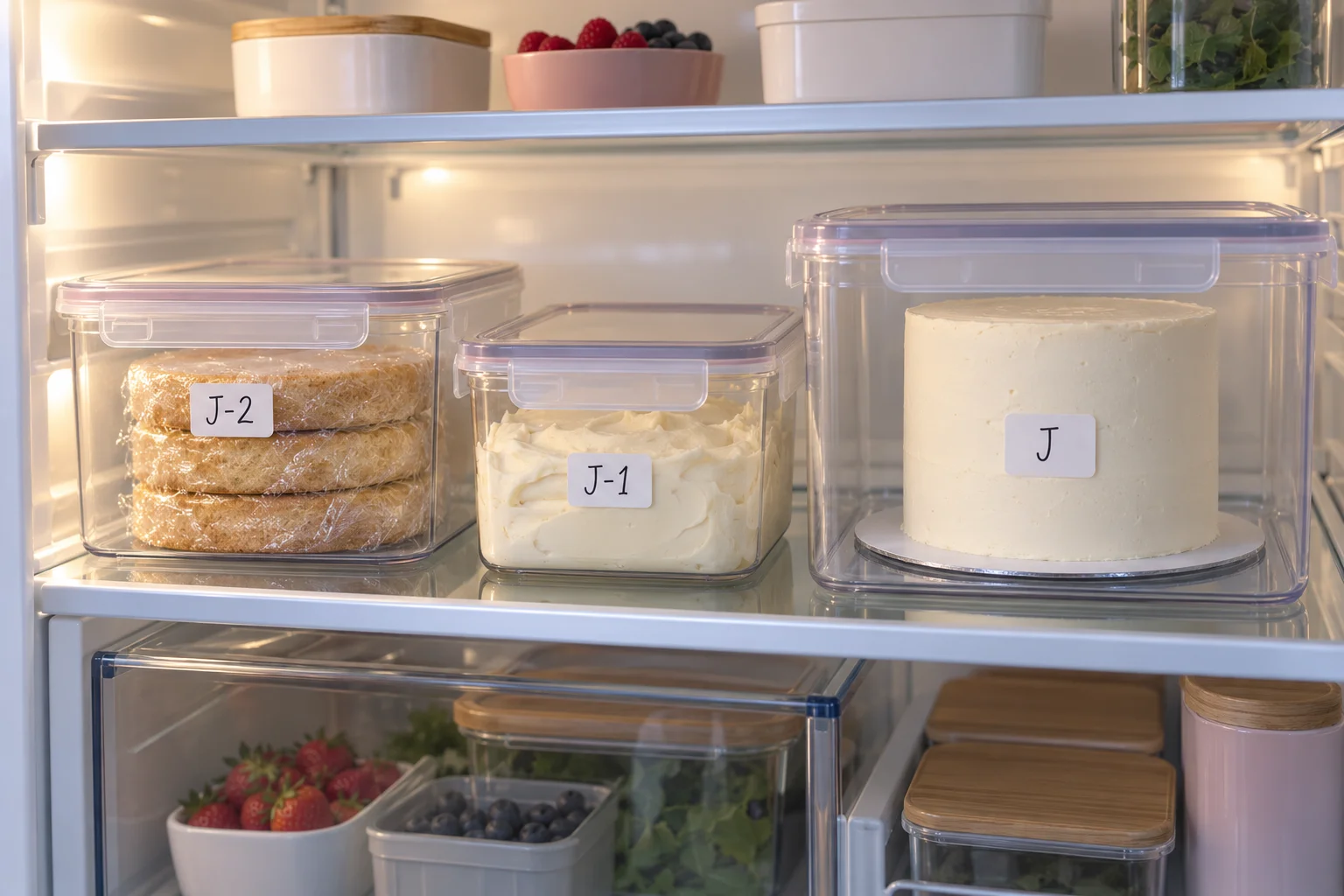
| Thursday (J-2) | Cooking sponge layers, syrup, dry decors (chocolat, sugar), complementary shopping | Chilled and filmed sponge layers, fresh or frozen |
| Friday (J-1) | Creams, levelling, mounting, underlay, blanket | Cake in the refrigerator, underlay taken before cover |
| Saturday (J) | Decor, photos, packaging, transport | Fragile decors laid at the last moment |
What can be anticipated
Each preparation has its own constraints. A duration not validated in a sheet becomes unsafe because it appears in a schedule; adapts anticipation to the reliable instructions of the chosen recipe.
- sponge layers: provide for cooling, packaging and storage after validated storage conditions for the recipe; the test sheet does not guarantee a duration.
- Syrup: prepare only the required quantity, cool quickly and store in a clean container closed in the refrigerator; duration to be validated.
- Ganache mounted: provide the rest in the refrigerator indicated by the recipe before whipping, within its validated shelf life.
- Dry decors: protect them from moisture and respect the specific indications of ingredients and formulation.
- Sensitive creams and cut fruits: preparation close to use, cold maintenance and limited handling.
Criteria rather than timetables
The schedule indicates moments, but we move on to the next step on criteria: cold sponge cake at heart, soft cream that holds on the spatula, firm underlayer to the touch. A cooling step does not shorten because the next one is scheduled at a fixed time.
The domestic cold chain
The refrigerator should be cooled to a maximum of 4 °C. Check it with a thermometer. Release an entire shelf before mounting: a cake on the cake board does not support the inclination or proximity of smelly foods (onion, cheese, leftovers).
Production sheet (planning) · Timer · Fridge thermometer · Cooling grids · Food film and closed boxes
The ingredients of the selected preparations, weighed according to the recipe sheets. · No improvised addition is required.
Set Result
Fix diameter, number of layers, cream, decor and delivery time. For a first cake, avoid combining new filling, new poaching technique and long transport.
List the preparations
Write for each preparation active work, cooling and rest. Check its conditions and shelf life; if this duration is not validated, do not plan for prolonged storage solely on the basis of this sheet.
Trace Dependencies
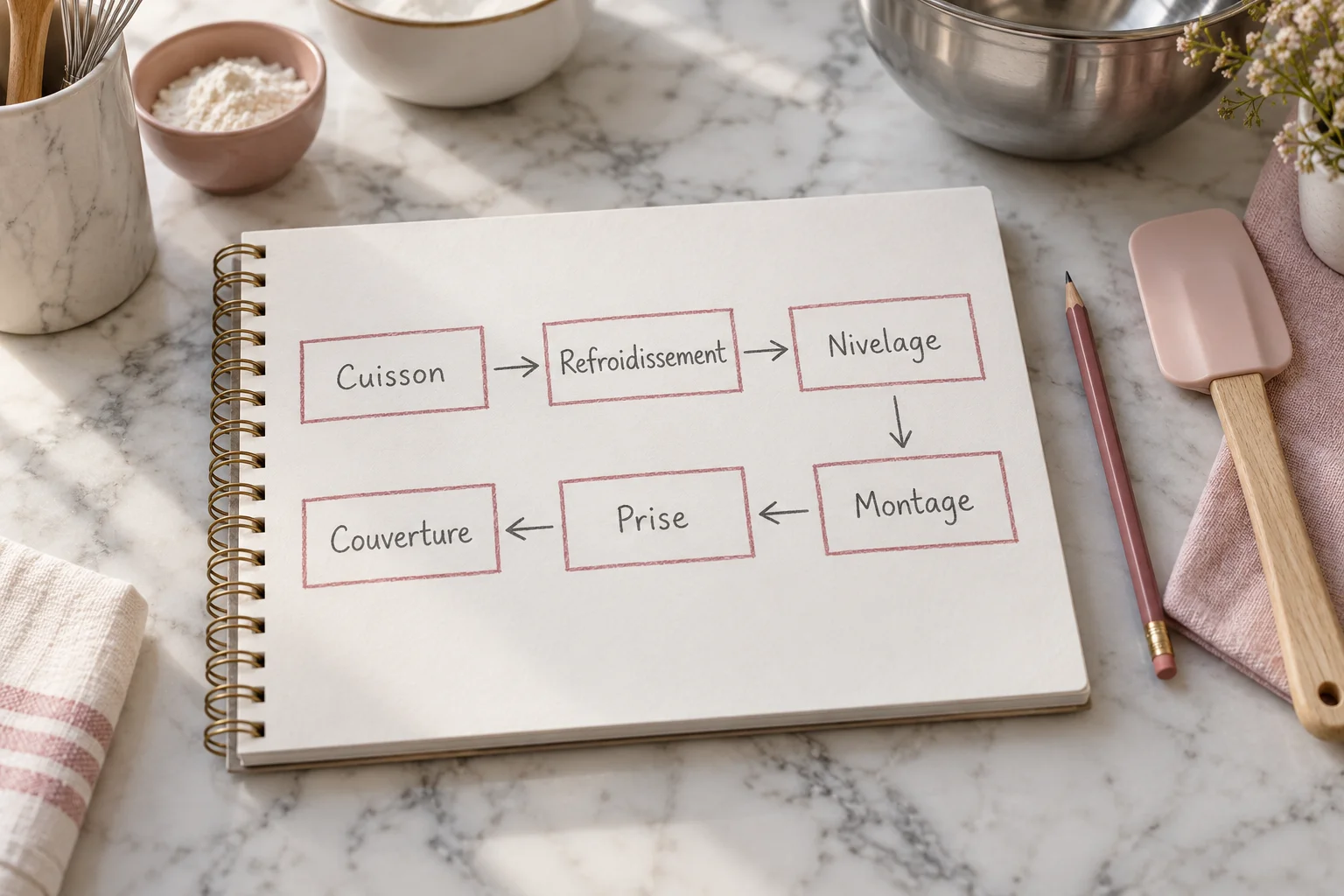
Link: cooking → complete cooling → levelling → mounting → socket → underlay → grip → cover → cold → decor. There's no arrow jumping.
Spread over three days
Place the preparations in table J-2, J-1, J depending on their storage. Reserve the cold slots and a one hour daily margin for unforeseen and cleaning.
Prepare the test form
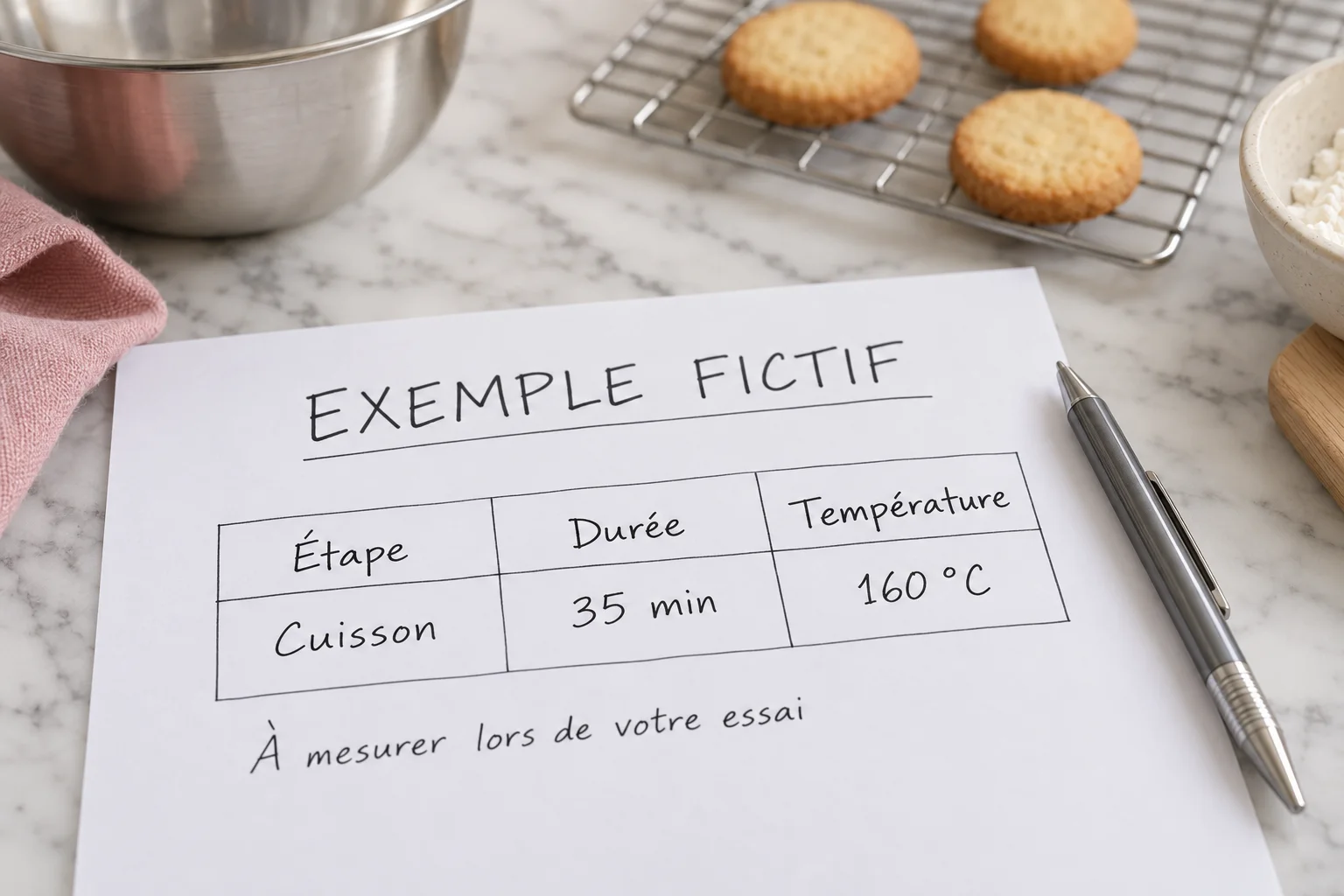
Plan a column to note what really happens: oven temperature, observed time, texture, sponge height, room temperature. On the next test, change a single parameter.
The right benchmarks
- The assembly never starts on a warm sponge cake.
- The schedule clearly distinguishes active work from waiting.
- A refrigerator shelf is released and controlled at a maximum of 4 °C.
- Fragile elements are planned on D-Day.
- A time limit exists every day.
If you miss the result
sponge cake still warm or too hot.
The gesture to be reviewed: Stop, put the sponge back in the cold and restore the texture of the cream before resuming.
The schedule only contains the recipes.
The gesture to be reviewed: Add equipment, packaging, cold storage and transport to the schedule.
Several parameters have changed without a written trace.
The gesture to be reviewed: Keep a dated sheet and change only one parameter identified at a time.
Next: Module 2: Choose useful material without buying unnecessary boxes.
Progression recorded on this device.